
June 5, 2026
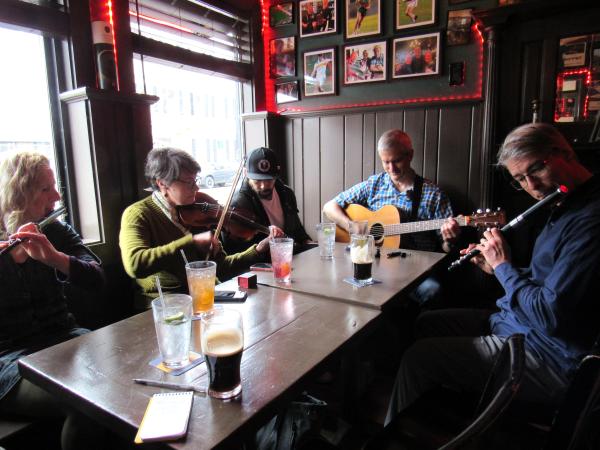
(L-R) Shannon Heaton, Cara Frankowicz, Evangelos Stowell, Matt Heaton and Nathan Weston kicked off the session at An Sibin. Photos by Sean Smith
Residents in the vicinity of Davis Square, Porter Square and Inman Square may not have realized it, but their neighborhoods played a key role in the debut of Greater Boston’s newest Irish music festival.
Tunes on the Charles , which took place April 30-May 3, featured performances, workshops, presentations and – most especially – music sessions, drawing listeners and onlookers, and musicians and dancers of all levels of experience. Organized by local musicians Colin Kadis and Sean Clohessy and dance performer/teacher Jackie O’Riley, the festival was modeled after those in Ireland that encompass local neighborhoods and towns and offer a panoply of events and activities, emphasizing camaraderie as well as culture.
Among the key pillars of support for Tunes on the Charles was the Dublin-based Irish Traditional Music Archive (ITMA), whose acclaimed “Drawing from the Well” series – spotlighting traditional Irish singers, musicians and dancers – made its U.S. debut with two sold-out evening shows on April 30 and May 1 at the 900-seat Somerville Theater.

The Druid session in full swing.
For the remaining two days, the festival proliferated into smaller venues – The Burren (Davis Square); The Druid, An Sibin and The Lilypad (Inman Square); and McCarthy’s/Toad and the Cambridge Masonic Hall (Porter Square) – with a schedule running from mid-morning into the evening.
Some tidbits:
•The “Drawing from the Well” concerts were simultaneously a triumphant event in and of themselves and a perfect stage-setter for the festival.
Its theme boiled down to this: The Irish music tradition should be preserved, but not inside an impenetrable glass case like some historical exhibit. The tradition influences and, in turn, is influenced; that’s been the case since the tradition was young.
“Traditional music at its best connects us with our past, present, and future,” ITMA Chief Executive Liam O’Connor, who played fiddle in the concert, wrote in its program guide. “Each generation leaves its mark on this shared cultural inheritance.”
A thorough review would easily run a thousand or more words (thus further prolonging this already protracted retrospective), but a glance at some of the performers alone reveals the breadth and depth of musical ability and creativity: Matt Molloy and Noel Hill, who have been wowing us for decades; next-generation talent like Doireann Ní Ghlacáin (niece of Paddy Glackin), Hannah O’Brien (niece of Mick) and Cormac Begley (son of Brendan); dancers Edwina Guckian, Caitlín Nic Gabhann (not so incidentally a marvelous concertina player as well), and Aidan Vaughan, for whom the adjective “ageless” is obvious but inevitable.
There were also local connections: the aforementioned O’Brien; the quintet of Tommy McCarthy, Louise Costello, Rose McCarthy, Harry and Peadar Giles; Joey Abarta; and the duo of Andrew Caden, a habitue of area sessions as a Boston College undergraduate, and Diarmuid Ó Meachair, whom Boston can claim as its own while he’s teaching at the College of the Holy Cross.
Singer-songwriter Aoife O’Donovan was a key element: a Boston-area native whose father Brian did so much for Irish/Celtic music, and whose creative influences include the sights, sounds, landscape and memories of Ireland – as she demonstrated in presenting her original “In the Quiet Hour” and the traditional Irish-American ballad “Lakes of Pontchartrain.”
“Drawing from the Well” functioned not only as a metaphor but as a message of encouragement for the festival, performers and audiences alike: Now that you’ve taken your sustenance and inspiration, go forth and put on a show yourselves.
•One of Tune on the Charles’ salient features was its “Session Trail”: Musicians could theoretically spend Saturday and/or Sunday shuttling between An Sibin, The Druid, McCarthy’s and The Burren, participating in regularly scheduled or specially arranged sessions, most lasting three hours.
Of course, finding parking in Cambridge and Somerville, especially on a typical Saturday, added a considerable degree of difficulty to doing the full Session Trail. So, unless you were really in shape for a lot of walking, you had to rely on bus or subway, or shell out for a taxi, Lyft or Uber. Then again, once settled into a session sweet spot, it’s hard to summon up a good reason to leave – unless you’re determined to experience more than one.
Saturday afternoon as rain clouds began moving in, the An Sibin session got underway, anchored by Cara Frankowicz (fiddle), Evangelos Stowell (concertina), and the Heatons (Matt on guitar, Shannon on flute). The four sat by a picture window looking out onto Cambridge Street, a few customers lingering nearby, and a little after 1 p.m. launched into a jig set beginning with “I Buried My Wife and Danced on Top of Her.” As they played, other musicians moved into the small space, waiting for a pause and assessing the seating arrangements.
When the quartet had finished the set, there were greetings and introductions for the arrivals, as well as brief discussions on such topics as the pleasures and challenges of commuting by bicycle: a perfect illustration of the craic, that much-desired characteristic of good sessions everywhere.

Uilleann pipers got in some tunes at McCarthy's Upstairs.
Some musicians came a fair distance – far more than from, say, Worcester or the Cape. One was Seattle fiddler and uilleann piper Lennart Jansson, a friend of numerous Boston-based musicians including the Heatons and festival co-organizer Colin Kadis (“He told me about the festival back in November, and I immediately put it on my calendar”). He was impressed by both the number and caliber of musicians from Ireland featured at “Drawing from the Well” and elsewhere during the weekend, and looked forward to attending a workshop in uilleann piping by Sean McKeon and recitals showcasing concertina and accordion as well as fiddle.
“Really just starting out here,” he said. “I’m curious what it will feel like after the sessions.”
Concertina player Jeni Hopkins had a somewhat shorter trip to Tunes on the Charles, coming from New York’s Finger Lakes region. “I’m always so happy to come to Boston and play with or listen to all the great musicians that are around,” she said, adding with a laugh that she would be spending considerable time “staring at the festival schedule.”
Barely five minutes’ walk away, the Druid session was pretty much at capacity, led by Christine Hedden (fiddle), Oisin McAuley (fiddle, guitar), John Morrow (tenor banjo) and Kelly Geraghty (concertina), with several other musicians filling out the allotted space – and a couple of others lingering nearby, either waiting for an opportunity to squeeze in or just enjoying some conversation.
A couple asked some of the musicians on the outer fringe if anyone could sing “The Foggy Dew,” the Fr. Charles O’Neill song about the Easter Uprising. Their request was relayed to others in the circle, but there was no immediate indication whether it would be fulfilled. So it goes. They seemed content enough to listen anyway.
By mid-afternoon, McCarthy’s was hosting a small session downstairs – led by owners/spouses Tommy McCarthy and Louise Costello – and a bigger one upstairs, featuring mainly elementary- and middle school-age musicians under the tutelage of fiddler/teacher Cliodhna Field. The latter gave way at 4 p.m. to an even more populous gathering organized by Boston’s Reynolds-Hanafin-Cooley Branch of Comhaltas Ceoltóirí Éireann; the leaders were fiddler Aoife Griffin and Co. Tyrone brothers James and Ciaran McKenna (concertina and piano, respectively), part of a seven-sibling band that is the fourth generation of the family’s music legacy.
Participants began placing chairs in a circle that, when complete, took up about a third of the space. They gradually settled into place, tuning up their instruments (those that could be tuned) and, of course, chatting. Among them was Jamaica Plain fiddler Holly Crow, who had thoroughly enjoyed the Friday night “Drawing from the Well” concert and a workshop earlier in the day with Donegal-born fiddler Ciarán Ó Maonaigh.
“This kind of experience gets me very excited,” said Crow, a classically trained violinist who classified herself as an intermediate-level fiddler. “I’m really motivated to practice now.”
A few yards away was Kevin Killeen, who had journeyed from New York’s Rockland County, a trip he’s made many times.
“I used to come up here very often to play with Larry Reynolds,” he said, referring to the celebrated fiddler, a towering figure in Boston’s Irish music community for decades. “Now there’s a whole new generation of musicians, and it’s very exciting to be around them.”
As the session got rolling, a succession of dancers took turns entering inside the circle, stepping through a couple of repetitions of the tune being played, then clearing the way for someone else. Musician, dancer, onlooker and occasional commentator – everybody played their part, and it felt like it could go on forever.
•Tunes on the Charles organizers – Jackie O’Riley in particular – made a point of ensuring that dance was in the mainstream of the festival, rather than at the margins.
“Dance can’t exist without music, and while music can exist without dance, when we bring them together it’s fascinating to see how they interact – and what dance can add to music,” said O’Riley in an interview with BostonIrish.com earlier this year.
Tunes on the Charles featured workshops in the sean-nos and Clare battering styles, the “St. Brigid’s Day” percussive dance, as well as set dancing; there was also a ceili with a live band to underline the dance-music partnership.
One woman enthusiastically related to an acquaintance her recent interest in sean-nos dancing; when she attended the workshop led by Edwina Guckian, she was surprised and pleased to find about 20 other people had signed up as well. “It was wonderful to see the interest, and you can get why sean-nos has become so popular: You don’t have to be really athletic, and there’s just a very special vibe to it,” she said, adding that she was impressed with Guckian’s teaching: “She would tell us, ‘Just feel it. Just feel it.’”
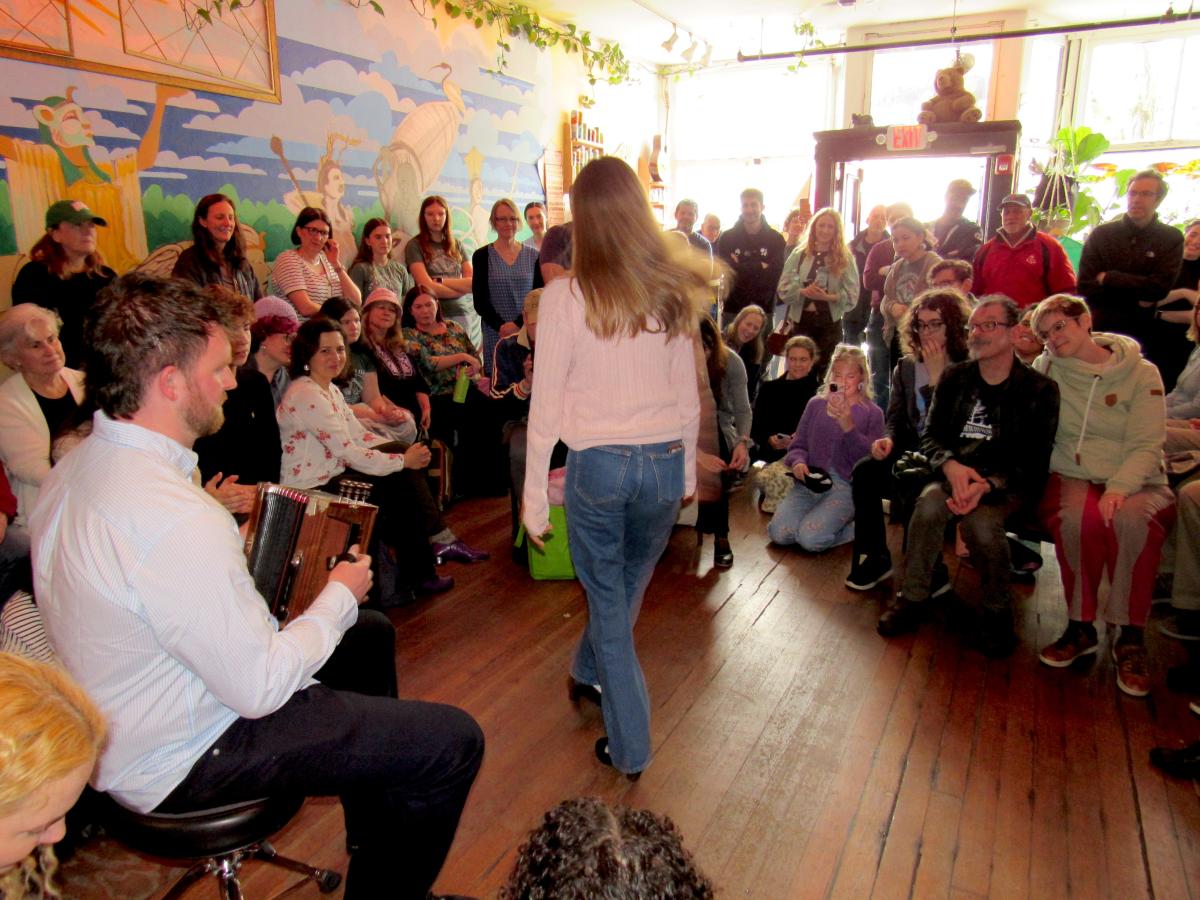
A rapt audience enjoyed "This Is Not a Competition" in The Lilypad.
Another dance highlight was “This Is Not a Competition,” a come-all-ye gathering in the cozy confines of The Lilypad spearheaded by Guckian. The premise was straightforward: You wrote your name on a piece of paper, put it in a hat, and when it was selected, you did any kind of Irish dance; then you put your name back into the hat, and if you were chosen again, you were the winner of a cash prize, based on donations.
The event was all in good fun, but as Guckian explained to the crowd at the beginning, there was a serious undercurrent. Dancers can get so caught up in the competitive environment of a feis, she said, they forget to enjoy themselves – even audiences can be skittish about being too enthusiastic about performances because they’re afraid to create a distraction.
“We want dancers to just be themselves,” said Guckian.
For the next hour or more, dancers each took a turn showing their stuff in a space roughly the size of a basketball court center circle. They represented all ages – there were more females than males – and performed just about every iteration of Irish dance: hard shoe, soft shoe, sean-nos, Clare battering, feis, set, ceili; there were soloists, duos, trios and more. Most were dressed casually (one sported a blue David Ortiz Red Sox shirt), but a few wore skirts or dresses.
Every routine elicited hearty cheers, but there were some that really upped the volume meter, notably those of “Drawing from the Well” performer Aidan Vaughan – especially when he exhibited his signature rapid whirl-around move – and Samantha Jones, who was dancing for two, being almost nine months pregnant.
At the periphery of the performance circle sat accordionist/melodeonist Diarmuid Ó Meachair, who provided the music for each routine. He consulted with the dancers on choice of tune, speed and duration (“Reels, medium tempo, three sets” for example), and was nothing if not amiable: When he played the wrong time signature for one dance, he apologized, “Sorry, I’m not very good at math.”
One of the best exchanges came when a dancer requested “Aidan Vaughan speed” for her dance. “Oh wow,” replied Ó Meachair, “so ‘Aidan Vaughan speed’ is a new metric?”
When all the dancers had finished, and before the winner’s name was drawn, O’Riley thanked performers and audience alike, expressing a general appreciation for the dance community’s conviviality and fellowship.
“We have everything we need here: passion, dedication and a love and respect for this great dance tradition,” she said to applause and cheers.
As those present provided a facsimile of a drum roll by rapidly stamping their feet, Guckian drew the winning name out of – appropriately enough – a Red Sox cap: Janine Susan, who announced she was donating the prize to the ITMA, which brought further acclamation.
And then, everyone who could manage to fit into the space got up for one more dance.
•Tunes on the Charles included two album launches at The Lilypad, "Once Through the House" by the Maine-based duo of uilleann piper Will Woodson and fiddler Caitlin Finley, and Bostonian singer-songwriter/multi-instrumentalist Jimmy Kelly's debut recording. Quincy native and accordionist David Healy also held the official Boston launch of his album "Down South" at McCarthy's Upstairs.
Local accordionist Colm Gannon, meanwhile, used the occasion to make a live album, joined by Sean Gavin, Caoimhin Ó Feaerghail and Pádraig Ó Dubhgaill for two two-hour recording sessions, one at The Lilypad and the other at the Toad portion of McCarthy's/Toad.
"This is not a concert with a set playlist," read the event description. "It's a recording session — meaning you'll hear the music being made, tune by tune, take by take. Expect the informal energy of a session, the focus of a studio, and the warmth of a room full of people who love this music."
All went quite well, Gannon reported afterwards; there'll be some mixing and other production, and then a release date will be announced.
•There were also events that involved talking about music-making, singing and dancing, including a lecture by Liam O'Connor about the ITMA and its work and an overview of the Boston College Irish Music Archives by BC Associate University Librarian for Scholarly Resources Christian Dupont. The Boston Uilleann Pipers Club hosted a presentation in McCarthy's Upstairs about the Coyne set of pipes that were played by the iconic Seamus Ennis, and after it was over – well, of course, those present took out their own pipes for a session. Following the requisite adjustments, six pipers began playing "Maid of Mt. Kisco" in unison as the bright afternoon sun ducked behind a cloud, the room swathed in a dim, filtered light.
•Co-organizer Sean Clohessy was, to put it mildly, quite pleased with Tunes on the Charles no. 1. “Seeing our music and dance community come together was really special and it felt quite significant to see them as integrated as they were. One of the Irish artists remarked to me that it was just like being at the Willie Clancy Summer School in Miltown Malbay – the energy, the music, the people, the storytelling, the craic. It was such high praise. Another mentioned several times to me that it was by far the best traditional music festival they had attended in the US.
“I think it really speaks to the authenticity of how music and dance is lived here in Boston and it was a real endorsement of the celebration of community that we hoped to create. We have received so much positive feedback from everyone involved, both from our own local community as well as the artists that traveled from Ireland.”
Of course, there’s the whole matter of putting together Tunes on the Charles no. 2, and Clohessy says he and the rest of the Tunes on the Charles team are more than willing.
“We really hope to be able to deliver something just as good, but it will be difficult to top this effort. We’re taking some time to enjoy a little peace and quite right now but hopefully we'll be getting together soon again to think about the logistics of doing this all again next year.”